
PART 4: Anyone Can Claim to Be an Expert — Here Is How to Tell the Difference
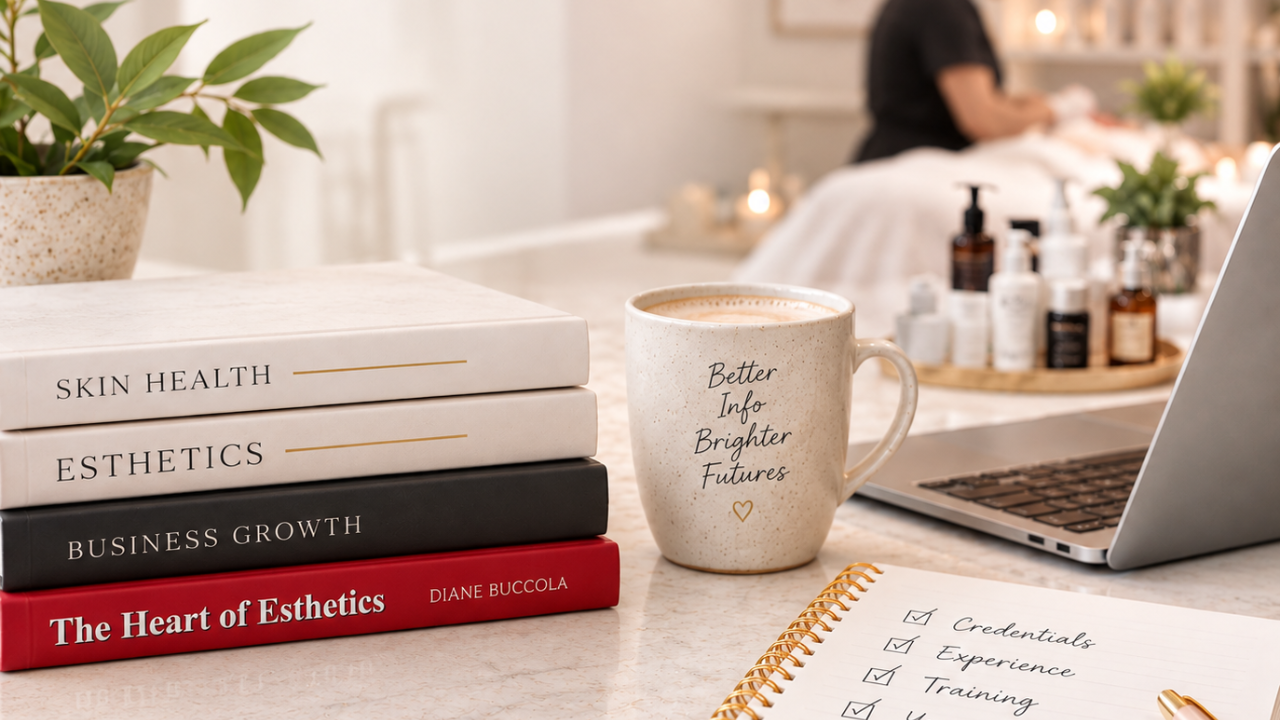
In the first three parts of this series we talked about what social media is doing to our profession, what clients really need from us, and how to evaluate the advice we are given. Today we are going to talk about the people giving that advice — and how to tell the real ones from the ones who simply look real online.
Earning your Esthetician license is not the endpoint. It is the beginning.
In this blog, I reach back into my early years as an Esthetician and day spa owner. (I was licensed in 1999) At that time, our service menus were very basic, and we all pretty much offered the same services; for example, the over-used “Anti-aging” facial. This of course is a misnomer because as long as we are living, there will be ageing…there’s no “anti” about it. Therefore, while Estheticians cannot prevent aging, they can certainly help their clients age beautifully.
Also common on service menus in those days was the European Facial which most of us learned in our esthetician licensing program. You’d also typically find acne facial, teen facial, gentlemen’s facial, and a peel on service menus. In other words, every potential client who looked at any spa menu in those days would see the same services listed.
SpaBizBoard
When I created SpaBizBoard in 2006, a whole new world opened up for us newbies. SBB was a paid subscription based online community which was only accessible to those who were personally vetted by me. Estheticians were required to submit their license info which I personally verified. SBB had members from all over the US and a few located internationally, which exposed us to all sorts of new information and creative ideas about services, products and most importantly post-grad training opportunities.
However, our community was not limited only to licensed Estheticians. We also had non-Esthetician members such as product manufacturers, reps, educators, etc., and they too were carefully vetted to confirm that they were currently and actively involved in our industry. Within the walls of SBB, we had a “private” area for licensed Estheticians only. This area allowed us to discuss in private what we were hearing from the non-Esthetician members; such as efficacy of products or equipment, business practices, etc. And when a member of SBB shared information with their clients, other Estheticians, or the public, it could be trusted.
The SpaBizBoard community operated in sharp contrast to the information today’s Estheticians may be receiving online. Currently, anyone with a computer can claim they are an expert. They can use AI to create books, courses, online groups, and impressive marketing campaigns; when the truth could be that they do not have any advanced training beyond their basic esthetician licensing course, or -- even worse -- they do not have an Esthetician license. And even if they do hold an Esthetician license and do have some advanced training, they may not be financially successful. But how will you know?
The concern about AI-generated content being used to create books, courses, and marketing campaigns by people with little or no real expertise is not only legitimate — it is something Estheticians, spa owners, and students are actively experiencing.
For newly-licensed Estheticians and students of esthetics: This is urgent! You, unknowingly, are the most vulnerable to AI-generated courses and self-proclaimed experts because you have not yet built the professional judgment to evaluate credentials critically. A newly-licensed esthetician who spends money on an AI-generated course from someone who has never stood behind a treatment table is not just wasting money — they may be internalizing information that will actively harm their practice and their clients.
For spa owners: This raises hiring and training concerns. If the person training your staff staff or advising you (or -- worse -- managing!) your business operations built their apparent expertise on AI-generated content and social media followings, rather than actual licensed experience, the consequences land in the spa owner's treatment rooms and on their clients' skin.
To circumvent this potential problem, review the questions I offered in Part 3 of this blog series; ask potential Estheticians, trainers, or managers specific questions about their hands-on experience.
"What’s in it for me?"
You will see in The Heart of Esthetics chapter 5, under “Uncomplicate your Menu,” I talk about naming – and properly describing -- the esthetics services on your menu. With few exceptions, most potential clients don’t know or care about the name of specific ingredients used in the facial as much as they care about how the facial will benefit them. Which means the “What’s in it for me?” question should be clearly answered within the description of the esthetic service.
It’s common that many Estheticians won’t grow beyond the product line they used in their esthetician licensing program. The exception would be those Estheticians who are hired as employees and then must use whichever product line the employer requires. But even so, if you ever plan to go solo someday, you must expand your knowledge about products, ingredients and services.
Today’s post-graduate education for Estheticians is typically presented by manufacturers and representatives of skin care products. And while it is important to keep up with the product line you are currently using, it limits your career growth. It’s important to learn about other product lines, other ingredients, other protocols. And if you still prefer your current product line, at least you will be well-informed and have information for purposes of comparison.
In my opinion, an Esthetician who continues to use and sell the same product line throughout his or her career is missing out on opportunities for growth. It is a fact that better products come out all the time and our clients deserve the best. Clients will appreciate that you are always in touch with the best products for your clients, which will lead to them placing their trust in you. And that is how a loyal clientele is created.
A successful Esthetician will also study information provided by neutral experts, who are not trying to sell you something. Much of this neutral information can be found within our trade magazines and at trade shows.
Earning your Esthetician license simply equates to being given the key that opens the door to the world of esthetics. It does not give you everything you need to become a rock star Esthetician, but it allows you to access to the real education in a career that is ever-changing.
THE HEART OF ESTHETICS by Diane Buccola
(Es-the-tish-uhn) n.
A person skilled in the art of skin care treatments; facials, waxing; well-versed in the subject of skin care and maintenance.
A smart individual who has contracted a case of skin health sense and is determined to spread the condition.
Synonyms: Aesthetician, skin care goddess, facial diva, sunscreen queen, friend, secret-keeper, holder of the key to the Fountain of Youth.
Common tools: Fan brush, steamer, extractor, tweezers, waxing sticks, magic wrinkle eraser.
ESTHETICIAN’S “JOBS”
When we first enter the esthetics business, we may think our primary job will be providing facial services, but after a while we realize that it’s a lot more than that. Every successful Esthetician knows that wearing many “hats” is part of the job.
- Analyst – This of course is our most important job and it’s what separates us from all the others. We use our education, training and licensure to analyze our client’s current skin condition and customize a treatment plan according to his or her specific skin care needs.
- Scientist – These skills are called upon regularly to assist us when assessing ingredients and recognizing possible contraindications.
- Psychic – If you have clients who buy products from you, then you have had the experience wherein clients will call, email or text when they want to replenish their home care supply. However, instead of giving you the proper name of the product, they will say something like “it’s that clear liquid that comes in a brown bottle and has a dropper, and the writing is gold.” That’s when you must tap into your psychic skills to figure out which product they are referring to. Of course, if you are keeping detailed records on each of your clients, you will be able to figure it out quickly, but mind reading is a skill that Estheticians do utilize occasionally.
- Techie – How about when a piece of equipment ships with less than optimum instructions? Or when equipment stops working in the middle of a service? And then there are websites that we are required to manage and keep updated. A Techie hat is definitely required for these tasks.
- Administrator – Record keeping, note taking, appointment scheduling, ordering, shipping, processing payment. We do it all.
- Consultant – Have you ever been in a social gathering with women and not talked about skin care services, products, wrinkles, anti-aging, etc.? If you’re anything like me, the answer is a NO.
- Wizard – Well, that’s just because we make magic happen. The Esthetician Magician!
- Friend – Over the long duration of my esthetics career, I have been part of landmark moments in my clients’ lives. Some of those landmarks include weddings, divorces, new babies, death in the family, important decisions and therapy sessions. It has been an honor and a privilege.
- Parent – Children of clients have come to me for various facial services and hair removal services over the years. In many cases, by virtue of my relationship with these young people, I ended up knowing more about their personal lives than their parents did! I have watched them grow up, date, get married, and have babies and I have been invited to the weddings and celebratory showers. What a joy!
- Advisor – For me, this is evidenced by my career as an author, speaker and mentor. It is the chapter of my esthetics career that I love most.
- Cheerleader – It is always a good feeling to have a positive impact on clients and know that I had a part in helping them feel fabulous.
The Heart of Esthetics by Diane Buccola
Back to blog #1: Reclaiming the Heart of Esthetics in the Age of Social Media
Creator

Diane Buccola
Author
Licensed Esthetician (CA), NCEA Lifetime Certified Esthetician (USA). Consultant, speaker, author, instructor.
